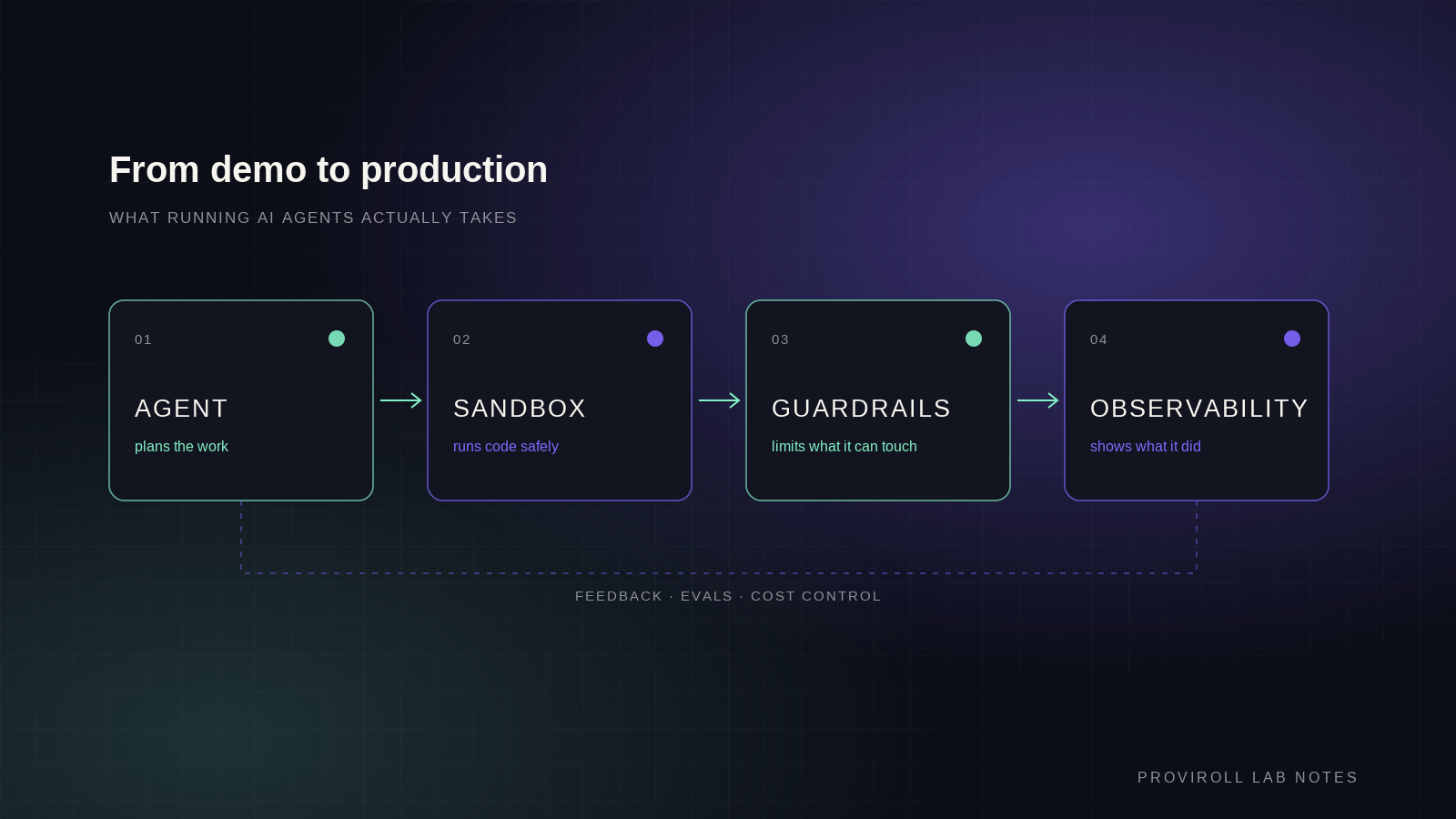
Building an AI agent demo has never been easier. Give a capable model a few tools, a clear goal and an afternoon, and it will do something impressive.
Running that same agent on real work, every day, with real customers and real data, is a different job. And most organisations are about to find that out.
The governance gap
A Gartner survey of more than 2,000 CIOs and technology executives, run in the second quarter of 2026, found that 71% of organisations expect to deploy agentic AI within the next 12 months. Only 21% said they have agentic AI governance capabilities in place today.
In November, Gartner went further, predicting that weak AI governance will lead to business-critical service disruptions for 40% of infrastructure and operations organisations by 2028.
The models are not the bottleneck. Everything around them is.
Five layers between a demo and production
1. A sandbox for every task
Agents that write or run code should never do it on shared machines. Each task gets its own isolated, disposable environment that disappears when the work is done. This is now a mature, affordable layer, with providers launching billions of sandboxes a year.
2. Guardrails and permissions
Give each agent the smallest set of permissions that lets it do its job, with credentials scoped to the task and short-lived. Anything irreversible, such as payments, deletions or messages to customers, waits for a human to approve it.
3. Observability
If you cannot see what an agent did, you cannot trust it. Trace every model call, tool call and decision, so a strange result can be explained in minutes rather than guessed at.
4. Evaluations
Agents change behaviour when prompts, tools or models change. A set of realistic test cases, run before every change, turns "it seems fine" into a measured answer.
5. Cost control
Agents can loop, retry and explore. Budgets per run, timeouts and clear limits keep a helpful agent from becoming an expensive one.
Start small, then widen the circle
The teams we see succeed pick one workflow with a clear measure of success, keep a human in the loop, and expand only once the numbers hold up. It is slower than a launch announcement, and much faster than recovering from an incident.
That is also how we work in our own lab: small bets, honest signals, and infrastructure that makes it safe to let agents do real work.