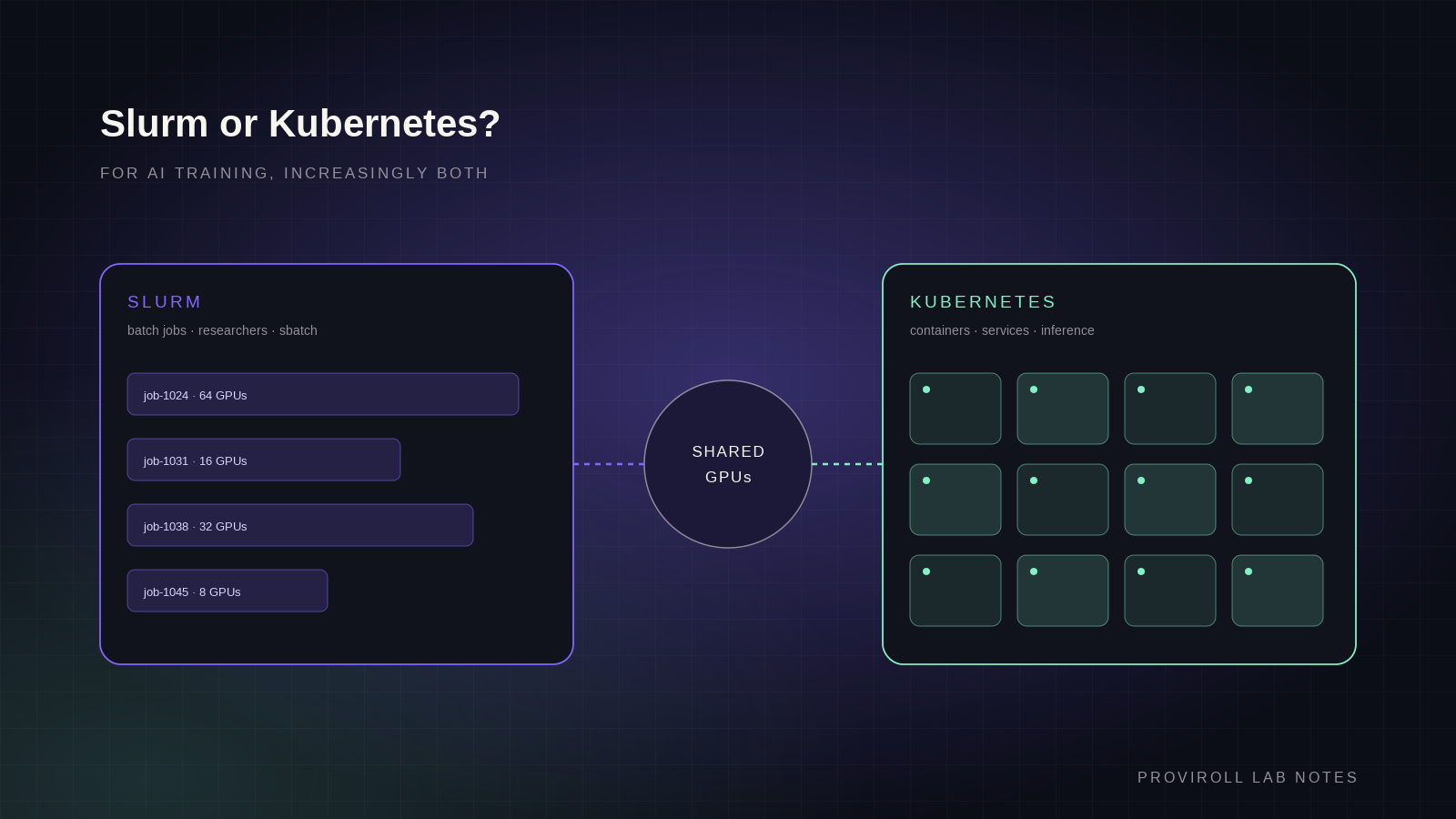
Ask a research team how they train models and many will say Slurm. Ask a platform team how they run everything else and they will say Kubernetes. For years, organisations with GPUs had to pick one, or run two separate clusters and accept idle capacity in both.
That divide is closing fast.
Two tools, two traditions
Slurm comes from high-performance computing, where it is one of the most widely used schedulers on the world's supercomputers. It is built for large batch jobs: request a number of nodes and GPUs, wait in a queue, run to completion. Researchers know its commands by heart, and it handles fair-share queues, accounting and topology-aware placement well.
Kubernetes comes from cloud services. It excels at long-running containers, autoscaling, rolling updates and the huge ecosystem of tools around them. That makes it the natural home for inference, data pipelines and the applications that sit around a model.
AI teams need both: training that behaves like a supercomputer job, and serving that behaves like a cloud service, ideally on the same pool of expensive GPUs.
Three ways to bring them together
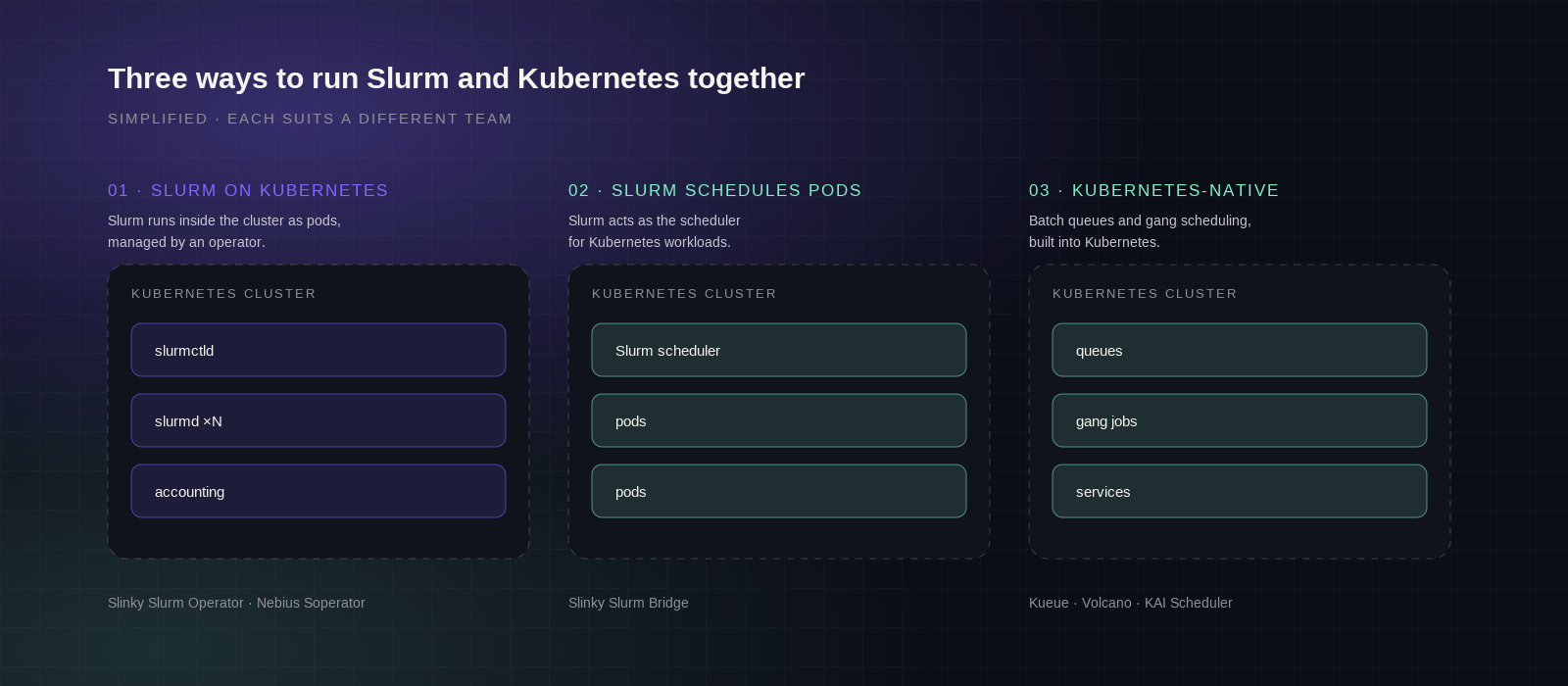
1. Slurm on Kubernetes
Slurm runs inside the Kubernetes cluster, with its controller, compute daemons and accounting managed as pods by an operator. Researchers keep their familiar workflow while the platform team manages one cluster.
Slinky, the open-source project from SchedMD, provides a Slurm Operator for exactly this. NVIDIA says it runs the Slinky operator in production across multiple clusters, some with more than 8,000 GPUs. Soperator, from cloud provider Nebius, is another open-source operator that takes a Kubernetes-first approach.
2. Slurm schedules Kubernetes pods
Slinky also includes Slurm Bridge, which lets Slurm act as the scheduler for Kubernetes workloads. It suits teams that trust Slurm's scheduling decisions but want their jobs packaged and run as containers.
3. Kubernetes-native batch scheduling
Some teams skip Slurm entirely and give Kubernetes the batch features it lacked: queues and quotas with Kueue, gang scheduling with Volcano, or NVIDIA's open-source KAI Scheduler for GPU-aware placement. This is often the simplest path for teams that are mostly serving models and only occasionally training them.
NVIDIA now owns Slurm's developer
In December 2025, NVIDIA acquired SchedMD, the company behind Slurm and Slinky. NVIDIA has said it will keep developing and distributing Slurm as open-source, vendor-neutral software.
Not everyone is fully reassured. Analysts have pointed out that an open-source licence is a safety valve, not a complete guarantee of neutrality. For most teams, the practical takeaway is to keep job definitions portable and avoid depending on features only one vendor's hardware supports, unless that trade-off is deliberate.
How to choose
- Your researchers live in Slurm and training dominates: run Slurm on Kubernetes, so they keep their workflow and you keep one platform.
- You mostly serve models and train occasionally: go Kubernetes-native with Kueue plus a gang-capable scheduler.
- You do plenty of both: share one GPU pool, with clear queues and quotas so training never starves production inference.
Whichever path you take, the goal is the same: fewer idle GPUs, fewer clusters to babysit, and researchers who can focus on the model rather than the machines. We help teams design and run exactly these platforms, from the first node to the thousandth.